
Reviews
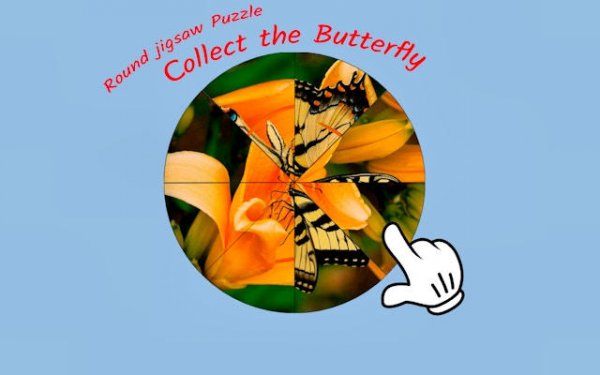
Butterfly Circle Puzzle succeeds by removing the scaffolding that traditional jigsaws rely on. Triangular fragments and a circular frame force you to read color and pattern rather than corners, which makes the first few minutes disorienting and the later stages satisfying. The absence of timers or scores supports a relaxed pace, and the swap mechanic works identically on desktop and touch screens. Players who want a puzzle that rewards patience rather than speed will find the format fits, while those who prefer conventional rectangular pieces may need time to adjust.
Description
Why the Circle Changes Everything
Most jigsaws give you a rectangular frame and straight edges to anchor your sorting. Butterfly Circle Puzzle removes that scaffolding. The image sits inside a ring, cut into triangular fragments that meet at the center and along curved boundaries. That geometry forces you to read the picture differently: colors and patterns matter more than corners, and radial alignment replaces the usual top-and-bottom logic. The result is a puzzle that feels familiar in goal but unfamiliar in method.
How Swapping Works
There is no dragging, no snapping, and no piece tray. You select one triangle and then select another to exchange their positions. On desktop, that means a click on the first fragment followed by a click on the second. On touch screens, a tap does the same job. The swap is immediate, so you can test a placement, see whether the edges line up, and reverse it without penalty if the colors clash. Because every action is a trade rather than a move, the board never grows or shrinks—only the picture resolves.
Reading the Butterfly
The artwork is the only guide. Symmetry helps: butterfly wings tend to mirror each other, so a fragment that looks wrong on the left may reveal its correct position when you find its counterpart on the right. Edge fragments define the outer circle and are usually the easiest starting point. Working from the center outward is another approach, since the middle triangles share boundaries with more neighbors and give you frequent alignment checks. Neither method is required; the game simply gives you the freedom to choose.
Pacing and Audience
No countdown, no score, no move limit. The game is built for players who want a mental task that does not punish hesitation. That makes it approachable for younger players and for anyone who prefers puzzles without pressure. The trade-off is that the circular layout can feel disorienting at first—traditional jigsaw habits do not transfer cleanly. Patience matters more than speed, and stepping away for a few minutes often makes a stubborn section easier to read when you return.
✅ Compatibility & Testing
FAQ
Comments
Sign in to comment
You must be logged in before posting a review or rating.
No comments yet. Be the first to comment!







Editorial Notes